I applied to Google AdSense for this site, expecting the technical setup to be the hard part. It wasn't — it's about twenty minutes of work, and most of it is copy-pasting values into the right places. The part that actually determines approval is something no snippet fixes: whether the site has enough real content. Here's what the technical checklist actually looks like, separated from the part that's genuinely about the content itself.
The technical checklist
Four things, all independent of each other:
-
Site verification. AdSense needs to confirm you own the site before it'll do anything else. The simplest method is a meta tag in
<head>:<meta name="google-adsense-account" content="ca-pub-XXXXXXXXXXXXXXXX"> -
The AdSense script itself, also in
<head>, on every page you want ads to eventually appear on:<script async src="https://pagead2.googlesyndication.com/pagead/js/adsbygoogle.js?client=ca-pub-XXXXXXXXXXXXXXXX" crossorigin="anonymous"></script> -
An
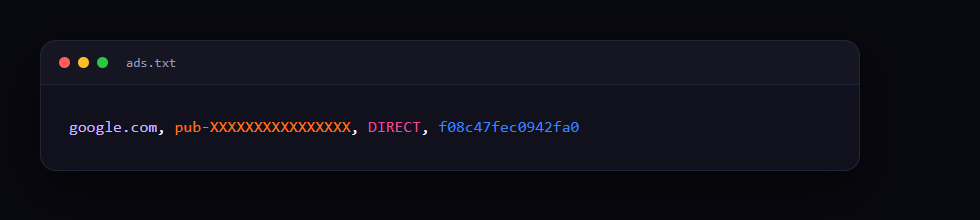
ads.txtfile at your domain's root — not a subfolder, the actual root:
This one trips people up because AdSense's dashboard can take up to a day to detect it even when the file is already live and correct — worth checking with a plaingoogle.com, pub-XXXXXXXXXXXXXXXX, DIRECT, f08c47fec0942fa0curlagainst the live URL before assuming something's actually wrong. - A visible privacy policy disclosing that the site uses AdSense, that Google may use cookies for personalized ads, and linking to opt-out options (Google's Ads Settings, and aboutads.info for the broader industry opt-out). This isn't optional once you're serving ads — it's a stated requirement, not a nice-to-have.
The part a checklist can't fix
None of the above addresses the most common rejection reason: "insufficient content" or "content quality issues." Google's own guidance for this is blunt — sites need enough original, substantive content to be worth a visit on their own, independent of ads. A single landing page, even a well-designed one, tends to read as "under construction" to an automated review, regardless of how polished it looks.
The honest fix isn't a trick — it's writing more real content. A few things that actually seem to matter: multiple full articles rather than one, each one long enough to say something substantive (not padded, just genuinely complete), pages that link to each other so the site reads as a coherent whole rather than isolated pages, and enough time and content for the site to look established rather than freshly assembled around the ad code.
What I'd tell someone starting this today
Do the technical checklist first — it's quick, and there's no reason to delay it. But don't expect it to be the reason you get approved or rejected. If you're building a personal site specifically to run ads on it, build the content first and treat AdSense as something you add to a site that already stands on its own, not the other way around. A reviewer — human or automated — is ultimately asking one question: would someone want to be here if there were no ads at all? Everything else is plumbing.